A Short Walk Through a Wide World by Douglas Westerbeke
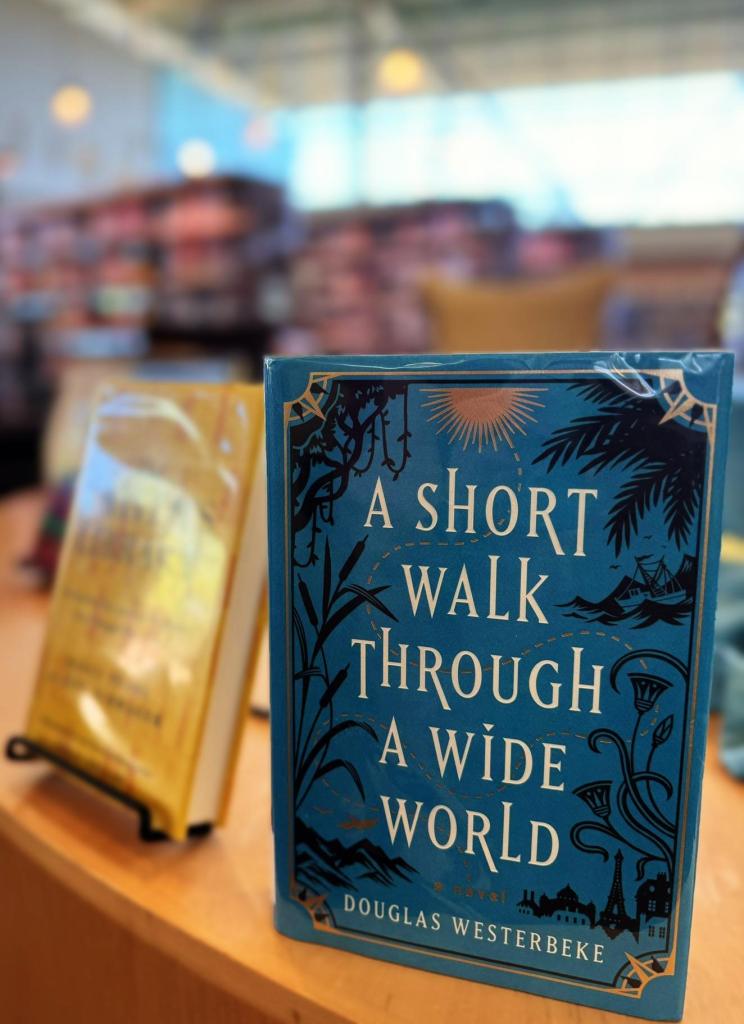
My Rating: 7/10

Synopsis: A little bit Addie LaRue, a little bit Midnight Library, a dash of Life of Pi, and perhaps the best antidote to my insatiable wanderlust.
Overview: Aubry Tourvel was cursed at a young age, forced to travel the world alone, never resting in one place for more than a few nights, never visiting the same place twice. Along the road she meets friends, lovers, admirers, strangers who recognize her face and her plight from newspaper articles. Some wish her harm while others push their own mortal boundaries to give her temporary shelter, safety, and in some instances, companionship for as long as they can.
Despite her near constant movement, she carries with her the connections she has built along the way, short lived as they may have been. Aubry’s is a life of solitude longing for lasting connection.
It’s also a tale of survival, adaptiveness, resourcefulness. Aubry must learn to survive, to provide for herself, to hunt and fish and trade for clothing and shelter and safe passage. She learns countless languages, becomes a master at non-verbal communication.
Just when her road ahead seems impossible, Aubry encounters a passageway to a secret library that serves as a portal to another place on earth. These libraries emerge in the most remote corners of the earth, at turns serving as sanctuary and as solitary confinement.
The story is beautifully written, and my heart broke for Aubry over and over again. However, it’s hard to ignore the loose plot threads, of which there are several.
I’m not suggesting, as a reader, that I need all the mysteries explained, like: What was the curses’ connection to the puzzle ball? Were the stories in the library from the curses’ previous victims? What was the point of the libraries? What’s the deal with Aubry of the future meeting Aubry of the past in the libraries?
But, there are a few things about which I would have appreciated walking away with some understanding. For example, what was the point of the curse forcing her to travel endlessly? It feels like there should be a lesson here, but it was lost on me. And why, when she was at the Prince’s fortress in India, did she think she could kill the curse by tying herself to the bedpost after she almost died when Uzair Ibn-Kadder essentially did the same? And what did she mean by “It used to be that my sickness pursued me…now, I chase it. Whenever it gets too near, I head out and hunt it down…”?
Despite the loose ends and the number of unanswered questions, I still thoroughly enjoyed this book and I’m looking forward to hearing what my friends thought of it during our discussion on Saturday. Perhaps they can shed light on some of these loose ends and make me see Aubry’s story through a different lens.
Discussion Questions: Of the fleeting connections Aubry made along the way, which did you feel was the strongest?
Who do you think was more affected by their encounter, Aubry or the people with whom she formed these short-lived relationships?
Have you ever had an encounter like that – a temporary relationship that left a lasting impression?
What do you think was the point of forced travel? Did she learn something along the way?
What was your take on the libraries? Were they real or imagined? What purpose did they serve?
Why do you think Aubry’s journey ended where it did?
Which of Aubry’s short-lived adventures would you have liked for her to linger on for longer?
Were you able to identify with any of her experiences?
If there is a message the author wants readers to take away from this book, what do you think it is?
What did you think? If you’ve read this book or plan to, I’d love to hear your thoughts. Happy reading friends!
 Renee Abberton
Leave a comment